
Your Complete Guide to Office Relocation (Without the Headaches)
Let’s be honest, moving offices ranks somewhere between root canals and tax audits on most people’s favorite-things-to-do list. But here’s the thing: it doesn’t have to be a nightmare. I’ve seen companies nail their office moves, and I’ve seen others… well, let’s just say they’re still finding missing staplers three months later.
Whether you’re moving because you’ve outgrown your space (congrats!), need to tighten the budget, or finally want that office with windows that actually open, this guide will help you get there without losing your sanity, or your favorite coffee mug.
Why Office Moves Feel So Overwhelming (And How to Change That)
Moving an office isn’t like moving your apartment where you can throw everything in your car and call it a day. You’re dealing with servers that cost more than some people’s cars, employees who’ve built emotional attachments to their desk plants, and clients who need to reach you without interruption.
The companies that make it look easy? They plan like their business depends on it—because it does. They know that a smooth move means:
- Employees who aren’t stressed about where their stuff is
- Clients who barely notice you’ve moved (in the best way)
- IT systems that actually work on day one
- A budget that doesn’t make the CFO cry
Step 1: Get Your Head in the Game (Goals, Money, and Time)
Before you start packing a single pen, sit down and figure out your “why”:
What’s driving this move? Are you bursting at the seams? Trying to cut costs? Finally ready for that open-concept space you’ve been dreaming about? Your reason will shape every decision that follows.
When do you need to be out? Here’s where I’ll save you from a rookie mistake: start planning 6-12 months out. I know that sounds like forever, but trust me, time flies when you’re juggling lease negotiations and trying to figure out if your ancient server will survive the trip.
What’s this going to cost you? And I mean really cost—not just the moving truck. Factor in new furniture, IT setup, that inevitable “oops we forgot about this” expense, and throw in a 10-15% buffer for good measure. Your future self will thank you.
Step 2: Assemble Your Dream Team (Or at Least a Functional One)
You can’t do this alone, and you shouldn’t try. Here’s who you need in your corner:
A Project Manager (that might be you—sorry): Someone who lives and breathes this move until it’s done. This person will become temporarily obsessed with spreadsheets and timelines, and that’s exactly what you want.
Your Department Champions: Get someone from IT who knows where all the cables go, an HR person who can handle the people side of things, and whoever handles your facilities. These folks will be your reality check when you suggest something that sounds good in theory but would be a disaster in practice.
The Pros: Unless you’re running a lemonade stand, hire professional movers. And yes, this includes specialized IT movers if you’ve got serious tech infrastructure. This isn’t the time to save money by asking Jim from accounting to move the servers.
Step 3: The Great Purge (A.K.A. “Do We Really Need This?”)
This is actually the fun part—or at least the most satisfying. You’re about to discover just how much stuff you’ve accumulated that serves no purpose beyond taking up space.
Be ruthless: That printer from 2010 that jams every third page? Time to go. The conference table that’s been a glorified storage unit for two years? Farewell, old friend.
Get organized: Create an inventory list that would make Marie Kondo proud. Use a color-coding system for boxes—trust me, “miscellaneous office stuff” isn’t helpful when you’re trying to find your stapler three weeks later.
Label like your life depends on it: Because finding your important files shouldn’t feel like a treasure hunt.
Pro tip: STOMO’s portable storage units are perfect for this phase. You can sort through everything at your own pace without your office looking like a tornado hit it.
Step 4: Don’t Let Your IT Infrastructure Become a Horror Story
Your computers, servers, and internet connection aren’t just nice-to-haves—they’re the lifeline of your business. Mess this up, and you’ll be explaining to clients why you’ve gone radio silent.
Scout your new space early: Send your IT person (or whoever knows a router from a server) to check out the new place. Are there enough outlets? Is the internet situation going to work? Can you actually fit your equipment where you think you can?
Give everyone a heads up: Your internet provider, phone company, and any other tech vendors need more notice than you think. “Hey, we’re moving next week” isn’t going to cut it.
Have a backup plan: Because something will go wrong. It always does. Having your most critical systems backed up means you won’t be completely dead in the water if there’s a hiccup.
Step 5: Communication is Everything (Seriously, Everything)
Remember that time your company made a big change and forgot to tell anyone until the last minute? Don’t be that company.
Keep your team in the loop: Regular updates, clear timelines, and honest answers to their questions. Yes, even the question about whether they can keep their desk plant.
Don’t forget your clients: They don’t need a play-by-play, but they should know you’re moving and how (or if) it affects them. Update your website, social media, business cards—all of it.
Create a FAQ document: Because you’re going to get asked the same questions seventeen times. Save yourself the trouble and write it down once.
Step 6: Moving Day (The Big Show)
This is where all your planning pays off—or where you discover what you forgot to plan for.
Have a command center: Designate someone to be the point person who can make decisions when (not if) something unexpected comes up.
Stay organized: Those inventory lists and labeling systems you created? This is their moment to shine.
Expect the unexpected: Traffic delays, missing keys, equipment that decides to malfunction—it’s all part of the adventure.
STOMO’s approach makes this day so much smoother. Their portable storage units can be delivered and moved according to your schedule, not theirs. No more waiting around for movers who show up three hours late.
Step 7: The Victory Lap (You Made It!)
You’re in! The worst is over, but you’re not quite done yet.
Do a walkthrough: Make sure everything made it safely and ended up where it’s supposed to be.
Test everything: Internet, phones, printers, coffee maker—the essentials of office life.
Celebrate: Seriously, you just pulled off something pretty impressive. Buy donuts for the team, host a happy hour, or at least acknowledge that you all survived what could have been a complete disaster.
Why STOMO Gets It Right
Look, I’ll be straight with you—moving companies are not all created equal. Some will show up late, handle your stuff like they’re playing rugby with it, and leave you wondering if your office equipment will ever work again.
STOMO is different because they understand that your business can’t just stop for a week while you move. Their portable storage units give you control over the timeline, their team actually shows up when they say they will, and your stuff stays secure throughout the entire process.
Plus, they’re not going to disappear the second they unload the truck. Need to store some things long-term? They’ve got you covered. Realized you need an extra unit? No problem.
Your Moving Timeline (So You Don’t Wing It)
6-12 Months Before: Get your ducks in a row—goals, budget, initial planning 3-6 Months Before: The great purge begins, start notifying vendors, begin the inventory process 1-2 Months Before: Finalize layouts, test everything at the new space, prep your team Moving Week: Last-minute packing, supervise the chaos, keep your sense of humor First Month: Unpack, troubleshoot, get back to normal (whatever that means)
The Questions Everyone Asks
Q: When should we start planning? A: Yesterday. Seriously though, 6-12 months gives you breathing room. Less than that and you’ll be making decisions under pressure, which rarely ends well.
Q: Can’t we just handle this ourselves? A: Could you? Maybe. Should you? Probably not. Professional movers have insurance, experience, and equipment you don’t. Your employees are great at their jobs—let them stick to that.
Q: How do we keep morale up during all this chaos? A: Communication, transparency, and acknowledgment that this is disruptive. Don’t pretend it’s no big deal—people appreciate honesty. And food. Food always helps.
Q: What could go wrong? A: A better question is what could go right. But since you asked: servers can crash, stuff can get lost, timelines can slip, and Murphy’s Law is alive and well. Plan accordingly.
The Bottom Line
Moving offices doesn’t have to be the stuff of nightmares. With the right planning, the right team, and the right moving partner, you can actually pull this off without anyone having a breakdown in the supply closet.
STOMO makes it easier because they understand that your business needs to keep running, your budget has limits, and your sanity matters. They’re not just moving your stuff—they’re helping you transition to your next chapter without losing what makes your business work.
Ready to get started? Reach out to STOMO and let’s make your office move the success story you’ll actually want to tell people about. Learn more below:
Table of Contents
- What Is Office Relocation Planning And Why Is It Important?
- Key Factors Influencing Office Relocation Decisions
- Understanding The Relocation Process: What Happens?
- Common Challenges In Office Relocation And Solutions
- How To Assess Success In Office Relocation Planning
Quick Summary
| Takeaway | Explanation |
| Thorough planning is essential for office relocations | A well-structured plan minimizes disruption and enhances efficiency during the move. |
| Employee communication improves morale | Clear communication helps manage expectations and reduces anxiety about the transition. |
| Financial evaluations guide effective decisions | Conducting a cost-benefit analysis is crucial to determine if relocation is a smart financial investment. |
| Assessing technology transfers ensures operational continuity | Carefully managing IT transitions is vital to avoid downtime and maintain productivity. |
| Evaluate cultural impact on employee dynamics | Understanding how relocation affects team cohesion can help in maintaining organizational performance. |
What is Office Relocation Planning and Why is it Important?
Office relocation planning is a comprehensive strategic process that involves carefully coordinating the movement of a business from one physical location to another. This intricate procedure requires meticulous preparation, coordination, and execution to ensure minimal disruption to daily operations. According to the Society for Human Resource Management, successful office relocation goes far beyond simply moving physical items.
Understanding the Core Components
At its foundation, office relocation planning encompasses several critical elements that determine the success of a business move. These fundamental components include:
Below is a table summarizing the critical components and their explanations, helping clarify what makes up successful office relocation planning.
| Core Component | Explanation |
| Comprehensive Asset Inventory | Detailed documentation of equipment, furniture, technology infrastructure, and sensitive materials |
| Resource Allocation | Strategic planning for financial, human, and logistical resources required for the move |
| Timeline Development | Creating a precise schedule that minimizes operational downtime |
- Comprehensive Asset Inventory: Detailed documentation of all equipment, furniture, technology infrastructure, and sensitive materials
- Resource Allocation: Strategic planning for financial, human, and logistical resources required for the move
- Timeline Development: Creating a precise schedule that minimizes operational downtime
The importance of office relocation planning cannot be overstated. A well-executed move can enhance workplace efficiency, improve employee morale, and potentially reduce long-term operational costs. Portable storage solutions like those offered by Stomo can significantly streamline this complex process.
Strategic Considerations for Success
Businesses must approach office relocation with a holistic perspective. This means considering not just the physical move, but also the potential impacts on employee productivity, company culture, and overall organizational workflow. Effective planning involves anticipating potential challenges and developing proactive strategies to address them.
Key strategic considerations include evaluating new workspace layout, ensuring technological infrastructure compatibility, managing employee communication and expectations, and maintaining business continuity throughout the transition. By treating office relocation as a comprehensive organizational initiative rather than a simple logistical task, companies can transform what could be a stressful experience into an opportunity for growth and improvement.
Key Factors Influencing Office Relocation Decisions
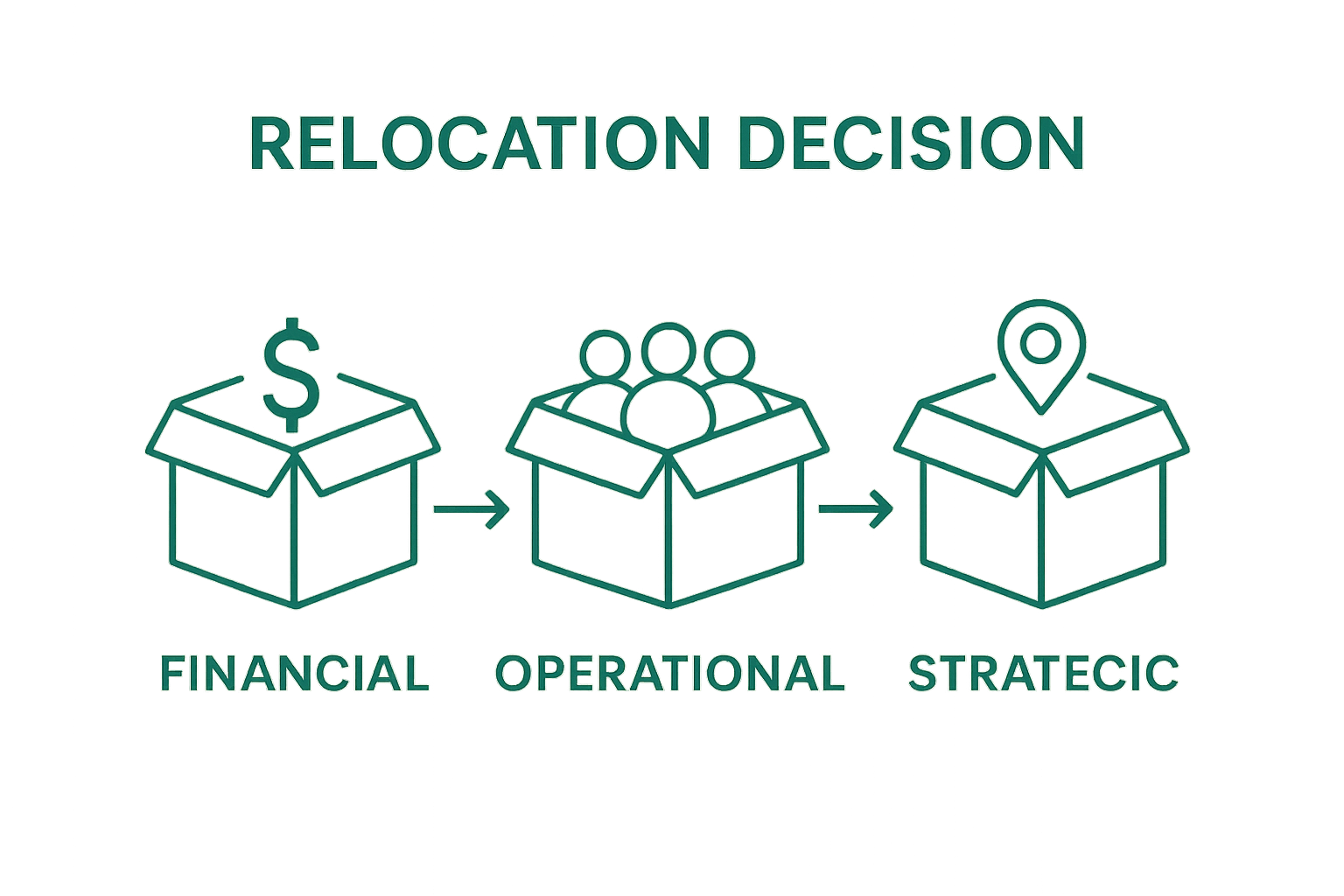
Office relocation is a complex decision that requires careful evaluation of multiple strategic and operational considerations. Companies do not simply choose to move on a whim but rather respond to a sophisticated set of interconnected factors that impact their business performance and growth potential. According to the Commercial Real Estate Development Association, successful relocations are driven by comprehensive strategic planning.
Financial Considerations
Financial implications play a pivotal role in office relocation decisions. Organizations must conduct thorough cost-benefit analyses that extend beyond immediate moving expenses. Critical financial factors include:
- Lease and Real Estate Costs: Comparing current rental expenses with potential new location pricing
- Operational Efficiency Savings: Potential reductions in overhead through improved workspace design
- Long-term Investment Potential: Future scalability and property value appreciation
These financial evaluations help businesses determine whether relocation represents a strategic investment or an unnecessary financial burden. Our guide on understanding moving costs provides deeper insights into these financial complexities.
Operational and Strategic Alignment
Beyond financial metrics, office relocation must align with broader organizational objectives. This includes assessing how a new location supports current business strategies, enhances workforce productivity, and positions the company for future growth. Key strategic considerations involve evaluating proximity to talent pools, accessibility for clients and employees, technological infrastructure compatibility, and potential market expansion opportunities.
Businesses must also consider the potential cultural impact of relocation. A new workspace can significantly influence team dynamics, employee satisfaction, and overall organizational performance. By treating office relocation as a holistic strategic initiative rather than a mere logistical exercise, companies can transform a potentially disruptive process into a powerful catalyst for organizational development and innovation.
Understanding the Relocation Process: What Happens?
Office relocation is a multifaceted journey that transforms a company’s physical and operational landscape. Far from being a simple change of address, the process involves intricate planning, precise execution, and strategic management across multiple organizational dimensions. According to the International Association for Human Resources Information Management, successful relocation requires comprehensive preparation and thoughtful implementation.
Pre-Move Planning and Preparation
The initial phase of office relocation demands meticulous groundwork that sets the foundation for a smooth transition. Organizations must develop a robust framework that addresses various critical aspects of the move:
- Comprehensive Inventory Management: Detailed cataloging of all physical assets, technology infrastructure, and sensitive materials
- Communication Strategy: Developing clear communication protocols for employees, stakeholders, and external partners
- Risk Assessment: Identifying potential disruptions and creating mitigation strategies
Our relocation guide for South Carolina businesses provides additional insights into local considerations that can impact the moving process.
Execution and Transition Phases
The actual relocation involves a carefully orchestrated series of activities designed to minimize operational disruption. This phase requires precise coordination between multiple teams, including facilities management, IT infrastructure, human resources, and external moving contractors. Companies must synchronize logistical elements such as equipment transportation, technology system migration, and workspace reconfiguration.
Critical to this process is maintaining business continuity. Successful organizations treat relocation as more than a physical move they view it as an opportunity to reimagine workspace design, enhance organizational efficiency, and potentially revolutionize internal workflows. By approaching the transition with strategic flexibility and comprehensive planning, businesses can transform a potentially stressful experience into a catalyst for organizational growth and innovation.

Common Challenges in Office Relocation and Solutions
Office relocations are complex endeavors fraught with potential pitfalls that can derail even the most meticulously planned moves. Understanding these challenges is crucial for organizations seeking to navigate the transition smoothly.
This table outlines common office relocation challenges and their corresponding solutions, making it easier to anticipate and address obstacles during a move.
| Challenge | Description | Solution |
| Technological & Infrastructure | Migrating IT systems, data, and network infrastructure | Careful planning, secure data migration, phased setup |
| Employee Adaptation & Culture | Employee anxiety, lost morale, culture shift | Transparent communication, support, engagement |
| Asset Management | Cataloging, safeguarding, and transporting physical assets | Detailed inventory, quality logistics partners |
| Business Continuity | Disruption to ongoing operations | Robust contingency plans, flexible scheduling |
Technological and Infrastructure Challenges
Technological transitions represent one of the most significant hurdles in office relocation. Organizations must carefully manage the migration of complex IT infrastructure, ensuring minimal downtime and maintaining operational continuity. Critical challenges in this domain include:
- Network and Communication Systems: Seamless transfer of internet, phone, and communication platforms
- Data Migration: Secure and accurate transfer of digital assets and sensitive information
- Hardware Relocation: Safe transportation and reinstallation of critical technological equipment
Our packing tips for smart moving can provide additional insights into managing these complex transitions effectively.
Employee Adaptation and Organizational Culture
Perhaps the most nuanced challenge in office relocation is managing the human element. The psychological and emotional impact of workplace transformation can significantly affect employee morale, productivity, and organizational cohesion. Successful relocations require a holistic approach that addresses both practical and emotional aspects of change.
Companies must develop comprehensive change management strategies that involve transparent communication, employee engagement, and support mechanisms. This includes providing clear information about the move, addressing individual concerns, and creating opportunities for employees to feel connected to the new workspace. By treating relocation as a collaborative journey rather than a unilateral decision, organizations can transform a potentially stressful transition into an opportunity for team building and organizational renewal.
How to Assess Success in Office Relocation Planning
Assessing the success of an office relocation extends far beyond measuring physical movement efficiency. It requires a comprehensive evaluation of multiple organizational dimensions that capture both tangible and intangible outcomes. According to research from leading workplace transition experts, successful relocations are measured through holistic performance indicators that reflect organizational health and employee experience.
Quantitative Performance Metrics
Objective measurements provide crucial insights into the effectiveness of office relocation planning. Organizations must systematically track key performance indicators that demonstrate operational impact:
- Productivity Benchmarks: Comparing work output before and after relocation
- Financial Performance: Analyzing cost savings, operational expenses, and investment returns
- Technology Transition Efficiency: Measuring downtime, system integration speed, and technological adaptability
Our renovation solutions guide offers additional perspectives on evaluating workplace transitions effectively.
Employee Experience and Cultural Adaptation
Beyond quantitative metrics, successful office relocation must be evaluated through the lens of employee perception and organizational culture. This involves understanding how the physical move impacts team dynamics, individual satisfaction, and overall workplace engagement. Organizations should conduct comprehensive surveys, focus groups, and individual interviews to capture nuanced insights into the relocation’s human impact.
Ultimately, a truly successful office relocation transcends logistical achievement. It represents a strategic transformation that aligns physical workspace with organizational vision, enhances employee experience, and creates an environment conducive to innovation and collaboration. By adopting a multifaceted assessment approach that balances objective measurements with subjective employee feedback, companies can transform office relocation from a mere logistical challenge into a powerful catalyst for organizational growth and renewal.
Make Office Relocation Simple and Stress-Free with Local Experts
Office relocation can feel overwhelming, especially when you have to balance asset inventory, coordinate multiple teams, and protect your productivity. The article highlighted how relocating your office is not just about moving things. It involves careful planning to minimize disruption, manage technology transitions, and make sure employees stay engaged and motivated throughout the process. When mismanaged, these challenges can hurt both company morale and your bottom line.
Ready for a smooth move in South Carolina? Discover how our Moving Services are built specifically to solve these pain points. We offer flat-rate pricing, reliable portable storage, and tailored moving support, so you avoid the stress and hidden fees common with national brands.

If you want to relocate your business with less risk and more confidence, choose the trusted local team awarded Best of Charleston in 2025. Visit stomostorage.com today to explore flexible solutions or browse our South Carolina service page for customized help in your city. Secure your move now and experience the personalized service only a family-owned business can deliver.
Frequently Asked Questions
What is office relocation planning?
Office relocation planning is the strategic process of coordinating a business’s move from one physical location to another, involving meticulous preparation, execution, and minimizing disruptions to daily operations.
Why is office relocation planning important?
Effective office relocation planning and interior design choices are crucial because it enhances workplace efficiency, boosts employee morale, and can reduce long-term operational costs, turning the relocation process into an opportunity for organizational growth.
What are the key components of a successful office relocation?
The core components of successful office relocation include comprehensive asset inventory, strategic resource allocation, and precise timeline development to ensure smooth execution and minimal downtime.
How can businesses assess the success of their office relocation?
Success in office relocation can be assessed using quantitative metrics like productivity benchmarks and financial performance, as well as qualitative measures such as employee satisfaction and cultural adaptation.