
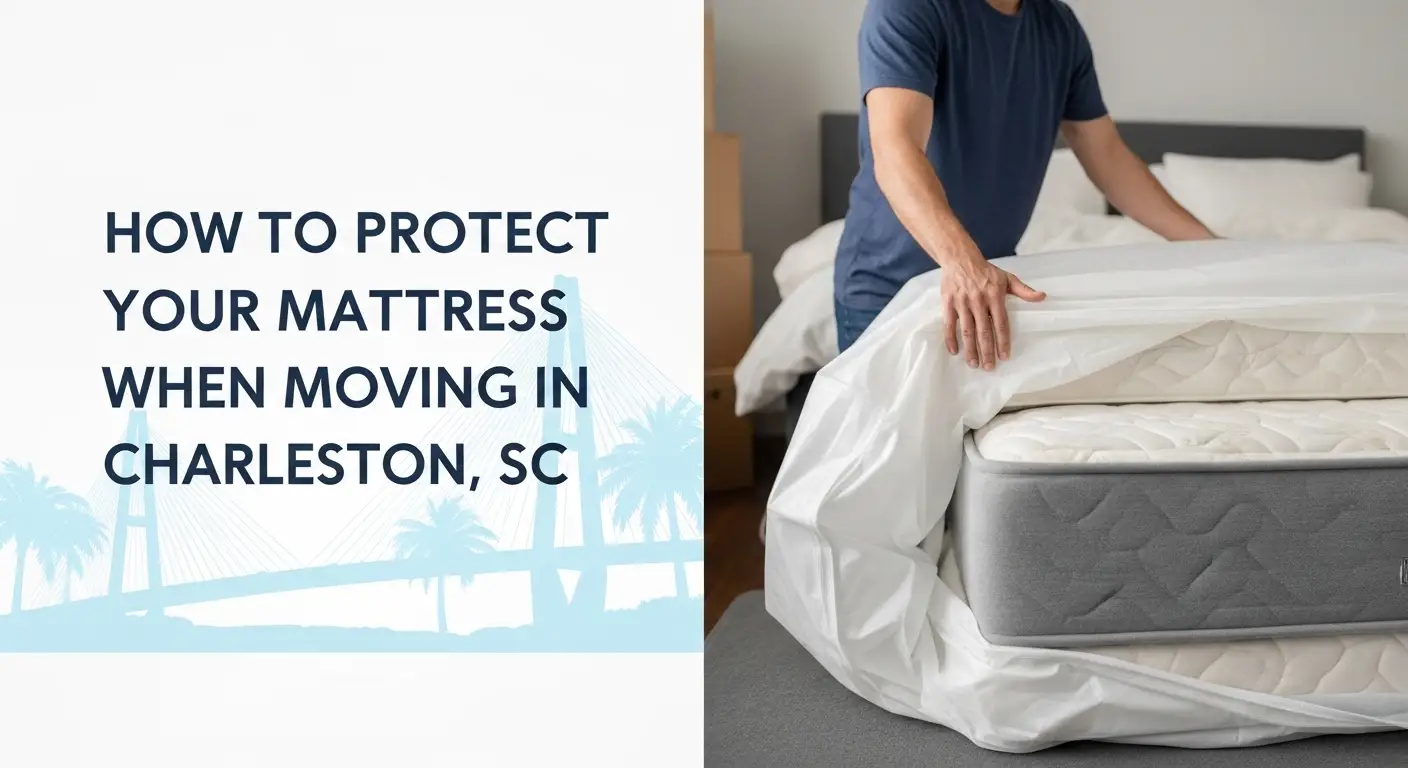
Your mattress is one of the most expensive things in your home. A decent mattress costs anywhere from $500 to $3,000. One bad move can ruin it for good. Moisture gets inside and causes mold. Dragging it across the floor tears the fabric. Bending it the wrong way breaks the springs.
The good news? You can protect your mattress from all of that with a few simple steps and the right supplies. This guide will walk you through everything from cleaning your mattress before you pack it, to loading it safely into the truck.
Quick Answer: How to Protect Your Mattress When Moving
To protect your mattress when moving: (1) clean and fully dry it before packing, (2) slide it into a heavy-duty mattress bag (4 to 6 mil thick) and seal it with moving tape in an X pattern, (3) wrap moving blankets around the outside for extra cushioning, (4) stand it vertically on its long edge when carrying it through doorways, and (5) secure it against the side wall of the moving truck with at least two ratchet straps. Never fold an innerspring or hybrid mattress, never stack heavy items on top, and always add a tarp in wet weather.
Why Protecting Your Mattress During a Move Actually Matters
A lot of people skip the protection step to save time or money. That is usually a mistake. Here is what can go wrong if you move your mattress without protecting it:
Moisture and mold. If your mattress gets wet even just a little mold can start growing inside the padding within 24 to 48 hours. You cannot see it from the outside, but over time it causes bad smells and serious health problems.
Tears and rips. Dragging your mattress across hardwood floors, concrete, or rough surfaces will tear the fabric and break open the seams. Once the cover is torn, the inside materials are exposed.
Bent or broken springs. Bending or folding an innerspring or hybrid mattress snaps the coils inside. You will feel lumps and dips the very first night you sleep on it at your new place.
Heat damage to memory foam. Memory foam is sensitive to heat. If it gets too hot during transport sitting in a hot truck or in direct sunlight it can lose its shape permanently.
Dust, dirt, and bed bugs. An unprotected mattress picks up everything it touches during a move of dirt, dust, and even bugs from floors and truck beds.
A heavy-duty mattress bag costs $10 to $25. That is a small price to protect a $1,000 investment.
What You Need Before You Start
Before you do anything, gather your supplies. You can find all of these at Home Depot, Walmart, Amazon, or U-Haul.
Must-Have Supplies
Mattress bag or cover. This is a large, thick plastic bag made specifically for mattresses. Look for one that is 4 to 6 mil thick. They come in sizes Twin, Full, Queen, King, and California King. Measure your mattress first so you get the right size. These cost $10 to $30.
Moving tape. Use real packing tape or moving tape. Do not use duct tape; it peels right off plastic bags, especially in heat or humidity. This is one of the most common mistakes people make.
Ratchet straps or tie-down straps. You need these to keep your mattress from sliding around in the moving truck. Ratchet straps are better than rope because they stay tight and do not loosen during the drive.
Scissors. Use scissors to open and trim the mattress bag. Do not use a box cutter; it is too easy to accidentally slice your mattress.
How to Choose the Right Mattress Bag
Not all mattress bags are the same. Here is what to look for when you shop:
Thickness matters. Look for a bag that is at least 4 mil thick. Anything thinner will tear too easily during the move. If you are doing a long-distance move or storing your mattress for a while, go for 6 mil.
Get the right size. Do not just look at Twin or Queen on the label. Measure the depth of your mattress too. Pillow-top mattresses and some hybrid mattresses are extra thick and will not fit in a standard bag.
Single-use plastic vs. zippered fabric covers. Single-use plastic bags cost $10 to $15 and work great for most moves. Reusable zippered fabric covers cost $20 to $40 and are better if you move often or plan to store your mattress for more than a month. Fabric covers let the mattress breathe, which helps prevent mold in humid climates.
Where to buy. Home Depot, Walmart, Amazon, and U-Haul all carry mattress bags. You can usually grab one in store on the day of your move.
Pro tip: For long-distance moves, buy two plastic bags and double-wrap the mattress. It adds a lot of protection for just a couple of extra dollars.
Step-by-Step: How to Protect Your Mattress When Moving
Step 1: Strip and Clean the Mattress
Remove all bedding, pillows, and the mattress topper and pack them in a box labeled “Unpack First.” Vacuum all sides of the mattress and spot clean any stains with a damp cloth do not soak it. Let the mattress dry completely for at least 2 to 4 hours before bagging it because sealing in moisture leads to mold. Take photos of any existing damage with your phone before you start packing so you have a record if you need to file an insurance claim later.
Step 2: Bag and Seal the Mattress
Lay the bag flat, slide the mattress all the way in with a helper, then push out as much air as you can before folding the open end over and sealing it with moving tape. Tape in an X pattern across the top, around the middle, and across the bottom in both directions to keep the bag from slipping off during the move. Wrap moving blankets around the outside and strap them in place for extra cushioning against bumps and door frames. For older floppy innerspring mattresses, tape cardboard sheets to the front and back before you carry it to make it stiffer and easier to handle.
Step 3: Plan Your Route
Measure your doorways, hallways, and stairwell width before moving day so there are no surprises. Walk the full path from the bedroom to the front door and remove anything in the way of lamps, picture frames, plants, anything breakable. If you live in an apartment building, reserve the elevator ahead of time and check if your building has time restrictions or loading dock rules for moving days. For older homes with narrow hallways or tight corners, removing a door from its hinges is often the easiest solution.
Step 4: Lift and Carry Correctly
Never move a mattress alone; you need at least 2 people for a Twin or Full, 2 to 3 for a Queen, and at least 3 for a King or California King. Bend at your knees when lifting, keep the mattress close to your body, and stand it on its long edge vertically to move it through doorways. Never try to carry it flat. Never fold or bend an innerspring or hybrid mattress even slightly because it breaks the internal coils permanently and voids most warranties. On stairs, the person in front guides while the person in back supports the weight and keeps talking to each other the whole time to prevent accidents.
Step 5: Load Into the Vehicle
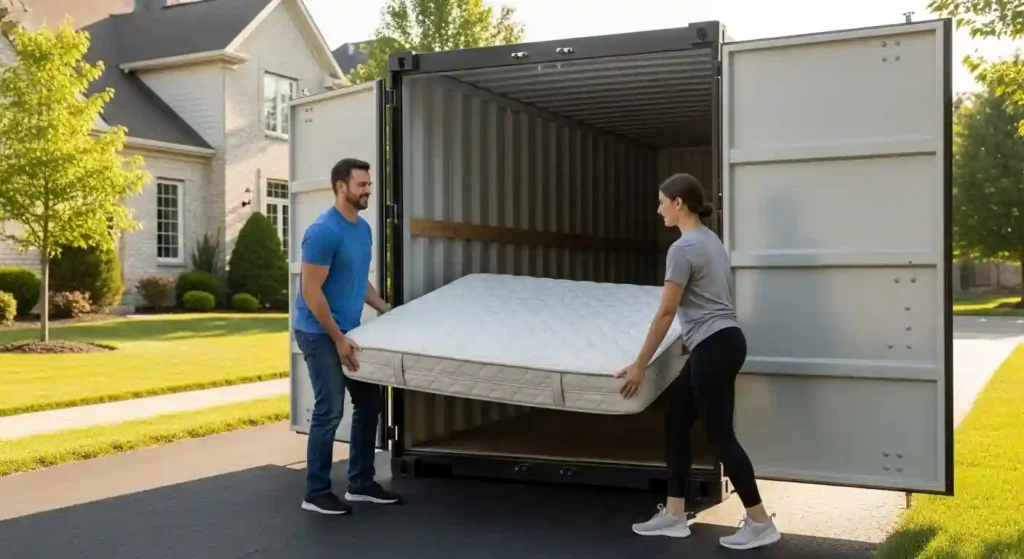
Stand the mattress vertically against the side wall of the moving truck or cargo van and use at least two ratchet straps one near the top and one near the bottom to secure it tightly. Slide lighter boxes alongside it for support but never lean heavy furniture against it or stack anything on top of it. Never transport a mattress on the roof of your car at highway speeds; it can fly off and cause serious accidents. Use a moving truck, cargo van, or portable storage container instead.
Special Situations to Know About
Moving a Memory Foam Mattress
Memory foam mattresses are more fragile than they look. Keeping them flat during transport if you can, laying flat is always the safest option. Moving them on their side is okay for short distances, but flat is better for long drives.Keep memory foam away from direct sunlight and heat during loading and unloading. Heat makes the foam soft and can cause permanent warping.Do not try to re-compress or re-roll a memory foam mattress after it has expanded. If you bought a bed-in-a-box mattress, it came vacuum-sealed from the factory. Once it expands, you cannot get it back into that state without special equipment.
Fiberglass warning: Many memory foam mattresses made after 2015 contain fiberglass inside the cover as a fire barrier. Do not cut or puncture the mattress cover during your move. If fiberglass fibers are released, they are a serious health hazard and extremely difficult to clean up from a room.
Moving a King or California King Mattress
You need at least 3 people. Some hybrid king mattresses weigh over 150 pounds, which is too much for two people to handle safely, especially on stairs. Measure all doorways twice. Standard king mattresses are 76 inches wide. Many older homes have doorways that are only 32 to 36 inches wide. You may need to remove the door from its hinges to get the mattress through. A California King is 84 inches long. That extra length makes staircases and tight hallways very tricky. Plan your exact route before moving day.
Moving in Rain or Bad Weather
Rain is one of the biggest threats to a mattress during a move. A plastic mattress bag alone is not enough protection in heavy rain. Add a tarp over the mattress after you load it and before you close the truck door.Never move a mattress in the rain without full waterproof coverage. A wet mattress can take up to a week to dry out completely. In humid areas, mold will start growing long before it dries. Check the weather forecast the night before your move. If rain is coming, adjust your schedule or have extra tarps and plastic wrap ready to go. Load the mattress last so it spends the least amount of time exposed outside. STOMO’s weather-resistant portable storage containers are built for Charleston’s unpredictable weather
Post-Move Mattress Care
You made it to the new place. Here is what to do next:
Remove the mattress bag carefully using scissors. Cut slowly and away from the mattress fabric.Let the mattress air out for at least 2 to 4 hours before you put any sheets on it. Open the windows to help with air circulation. This lets any trapped moisture escape.For memory foam mattresses, give it 24 to 48 hours to fully decompress and return to its normal shape. It may look a little flat or uneven at first, which is completely normal. Just give it time.Inspect the mattress for any new damage right away. If something happened during the move, take photos and document it immediately for insurance purposes. Do not place heavy items on top of the mattress during the first night while it is still settling back into shape.
Common Mistakes to Avoid
Skipping the mattress bag. A $15 bag protects a $1,000 mattress. It is always worth the small expense.
Using duct tape. Duct tape does not stick well to plastic, especially in heat or humidity. Always use real packing tape or moving tape.
Folding an innerspring or hybrid mattress. This breaks the coils inside permanently. The damage cannot be undone and most warranties will not cover it.
Dragging across hard floors. Dragging across hardwood, tile, or concrete tears the mattress bag and the fabric underneath. Use furniture sliders if you need to move it across the floor without a full lift.
Putting heavy things on top in the truck. Stacking furniture or boxes on your mattress causes permanent dents in the comfort layer.
Moving in rain without a tarp. Rain plus humidity equals mold. Use a tarp as a second layer of protection any time the weather is wet.
Storing upright long-term. Standing a mattress on its edge is fine for a move. But if you are storing it for more than two weeks, lay it flat. Long-term upright storage causes the mattress to warp and lose its shape.
Moving to Charleston? STOMO Makes It a Lot Easier
Moving a mattress is already hard work. Adding a truck rental deadline on top of it makes everything more stressful. STOMO delivers portable storage containers directly to your home in Charleston, Mount Pleasant, West Ashley, James Island, and surrounding areas. You pack at your own pace, no rushing, no return deadline to stress about. Our weather-resistant containers protect your mattress and everything else from Charleston’s heat, rain, and humidity throughout your entire move. Need to store your mattress for a few weeks while you get settled into your new place? We handle that too.
Get a Free Quote from STOMO Today. No truck rental, no rushing, just a simple, stress-free move on your schedule.
Frequently Asked Questions
Do I really need a mattress bag for a short local move?
Yes. Even a quick move across town can damage an unprotected mattress. Doorways scratch the fabric, floors leave dirt and tears, and rain can show up unexpectedly. A mattress bag costs $10 to $25 and takes about 10 minutes to put on. It is always worth it.
Can you fold a mattress to move it?
Only certain all-foam mattresses can be folded — and only if the manufacturer specifically says it is okay, and only if the mattress is less than 11 inches thick. Never fold an innerspring, hybrid, or latex mattress. Folding those breaks the internal structure permanently and voids most warranties.
How many people do you need to move a mattress?
You need 2 people for a Twin or Full mattress. You need 2 people minimum for a Queen, though 3 is better if you have stairs. You need at least 3 people for a King or California King. Some heavy hybrid king mattresses genuinely need 3 to 4 people to move safely.
Can I move a mattress on the roof of my car?
Experts strongly advise against it. At highway speeds, a mattress is very likely to fly off the roof and land in traffic — causing serious accidents. The mattress also gets damaged from wind pressure and ratchet strap compression. Use a moving truck, a cargo van, or a portable storage container instead.
How long should I let a mattress air out after moving?
Give it at least 2 to 4 hours before putting sheets on it. If you have a memory foam mattress, give it 24 to 48 hours to fully decompress and return to its normal shape. Keep the room ventilated and avoid sleeping on it until it has fully settled.