
Moving means you need boxes, there’s no way around it. But how many exactly? That’s the tricky question. The answer depends on your home size, how much stuff you own, and your lifestyle. A studio apartment needs far fewer boxes than a 5-bedroom house. A minimalist needs less than a collector.
This guide works like a moving box calculator. You’ll find three ways to figure out your needs: by home type (apartment vs house), by room count, and room-by-room breakdown. Each method helps you plan better. The average home needs about 60 boxes total, but you might need 30 or you might need 200. Let’s figure out your number.
One important thing: always get extra boxes. Running out mid-move is stressful. It’s easier to return unused boxes than make emergency store runs on moving day.
What Affects How Many Boxes You Need?
Six main factors determine your box count. Think about these before you start buying:
Home size matters most. A 700 square foot apartment needs fewer boxes than a 2,500 square foot house. More space usually means more stuff.
Time spent in your home adds up. Most people gather more items each year they stay in one place. Lived there 10 years? Expect more boxes than someone who moved in last year.
The number of people in your household multiplies your needs. Each person has their own stuff. Don’t underestimate kids – they accumulate a lot. Each extra person adds 20-30 boxes typically.
Your lifestyle changes everything. Minimalists need the lower end of estimates. Average people fall in the middle.Have lots of stuff? Use the higher numbers, be honest about which category you fit.
Recent decluttering helps a lot. Gone through closets lately and donated items? You’ll need 20-30% fewer boxes than someone who hasn’t purged in years.
Storage spaces count too. Houses with garages, basements, and attics need way more boxes than apartments without these spaces.
The most accurate way to know? Hire a professional moving consultant for an in-home survey. They’ll give you exact numbers. But our tables below work great for planning and budgeting.
Understanding Box Sizes and What Goes Inside
Not all boxes work for all items. Here’s what you need to know.
| Box Size | Dimensions | Cubic Feet | Weight Limit | Best For | Don’t Pack |
| Small | 16″x12″x12″ | 1.5 | 20-30 lbs | Books, tools, kitchen utensils, small appliances, canned goods | Lightweight bulky items |
| Medium | 18″x18″x16″ | 3 | 20-30 lbs | Kitchen items, toys, decor, folded clothes, office supplies | Too many books |
| Large | 24″x18″x18″ | 4.5 | 30-40 lbs | Bedding, towels, pillows, lampshades, shoes | Heavy items |
| Extra-Large | 24″x18″x24″ | 6+ | 30-40 lbs | Comforters, bulky pillows, sports gear, large toys | Dense or heavy items |
Specialty Boxes You Might Need
Wardrobe boxes have a hanging rod built in. Each box holds about 2 feet of closet space. Measure your closets in feet, then divide by 2. That’s how many wardrobe boxes you need.
Dish barrel boxes have extra-thick walls for plates, bowls, and glasses. Each box holds about 16 pieces or one 4-piece place setting. Count your dishes to figure out how many you need.
TV boxes adjust to fit flat screens up to 70 inches. Don’t risk your expensive TV in a regular box.
Mirror and picture boxes are flat and adjustable. They prevent cracks and scratches on artwork and mirrors.
These specialty boxes cost more but save you money. Broken dishes and cracked TVs cost way more than a few specialty boxes.
How Many Boxes for Apartments vs Houses
This is your main calculator. Apartments and houses need different amounts because houses have garages, basements, and attics.
How Many Boxes for Apartments
Apartments typically need fewer boxes since they lack extra storage spaces.
How Many Boxes for a Studio Apartment
Plan for 30-50 boxes total. Studios run about 500-600 square feet. You’ll need:
- 10-15 small boxes
- 9-17 medium boxes
- 5-6 large boxes
- 2-7 extra-large boxes
- 3-4 wardrobe boxes
- 2-3 dish barrel boxes
Minimalists hit the lower numbers. Average people need the middle range. Use upper numbers if you’ve lived there a while.
How Many Boxes for a 1 Bedroom Apartment
Expect 45-75 boxes total. That separate bedroom adds a lot. You’ll need:
- 15-23 small boxes
- 15-29 medium boxes
- 7-11 large boxes
- 4-9 extra-large boxes
- 3-4 wardrobe boxes
- 2-3 dish barrel boxes
The bedroom adds clothes, bedding, and personal items. This jumps your count way up from a studio.
How Many Boxes for a 2 Bedroom Apartment
Budget for 80-120 boxes total. Second bedrooms mean way more stuff. You’ll need:
- 24-37 small boxes
- 21-38 medium boxes
- 15-20 large boxes
- 10-12 extra-large boxes
- 5-8 wardrobe boxes
- 4-6 dish barrel boxes
Two people living together? Each person adds their own belongings. That second bedroom gets used for offices, guest rooms, or storage.
How Many Boxes for Houses
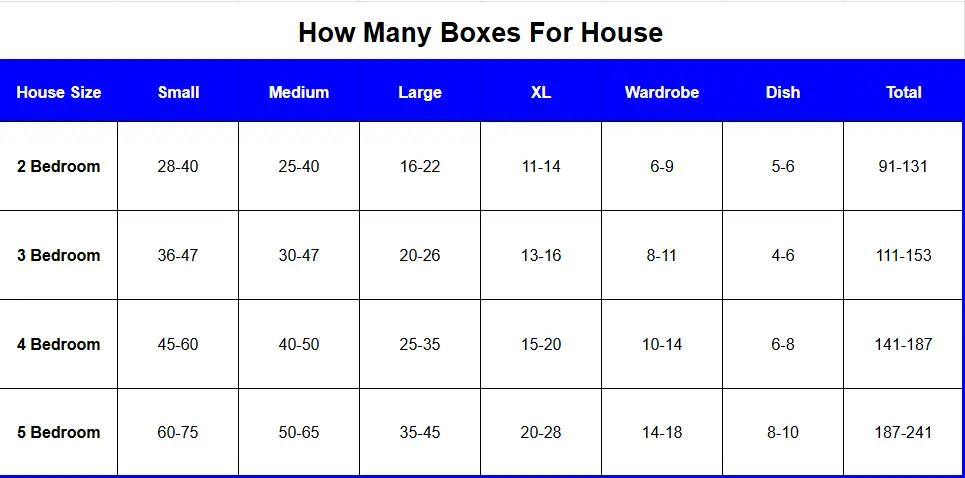
Houses need more boxes than apartments because of garages, basements, attics, and sheds.
How Many Boxes for a 2 Bedroom House
Plan for 90-130 boxes total. Even small houses have storage spaces apartments lack. You’ll need:
- 28-40 small boxes
- 25-40 medium boxes
- 16-22 large boxes
- 11-14 extra-large boxes
- 6-9 wardrobe boxes
- 5-6 dish barrel boxes
The garage alone adds 10-20 boxes for tools, lawn equipment, and seasonal items.
How Many Boxes for a 3 Bedroom House
Expect 110-150 boxes total. This is America’s most common house size. You’ll need:
- 36-47 small boxes
- 30-47 medium boxes
- 20-26 large boxes
- 13-16 extra-large boxes
- 8-11 wardrobe boxes
- 4-6 dish barrel boxes
Don’t forget your garage, basement, and attic. These spaces alone can add 30-50 boxes to your total.
How Many Boxes for a 4 Bedroom House
Budget for 140-185 boxes total. Larger families have way more stuff. You’ll need:
- 45-60 small boxes
- 40-50 medium boxes
- 25-35 large boxes
- 15-20 extra-large boxes
- 10-14 wardrobe boxes
- 6-8 dish barrel boxes
Each extra person adds 15-25 boxes worth of belongings. Four bedrooms often mean more bathrooms and living spaces too.
How Many Boxes for a 5 Bedroom House
Plan for 185-240 boxes total. These big homes have tons of storage areas. You’ll need:
- 60-75 small boxes
- 50-65 medium boxes
- 35-45 large boxes
- 20-28 extra-large boxes
- 14-18 wardrobe boxes
- 8-10 dish barrel boxes
Five bedroom houses often have workshops, hobby rooms, or multiple storage areas that add lots of packing needs.
Why houses need more: Garages add 10-20 boxes. Basements add 15-30 boxes. Attics add 10-20 boxes. Sheds add 5-15 boxes. That’s 40-85 extra boxes just from storage spaces.
How Many Boxes Room by Room

Want more detail? Here’s what each room typically needs.
Kitchens need the most boxes. Plan for 2-4 small, 5-6 medium, 2-4 large, 2 extra-large, and 4-6 dish barrel boxes. American kitchens average 160 square feet. All those dishes, appliances, and utensils add up fast.
Living rooms need 2-4 small, 3-4 medium, 2-4 large, and 1-2 extra-large boxes. Unless your living room is a library, it should pack up pretty easily.
Dining rooms need 1-2 small, 1-2 medium, and 2-4 dish barrel boxes. Fine china goes in dish barrels with lots of padding.
Master bedrooms need 1-3 small, 5-6 medium, 5-8 large, and 4-6 wardrobe boxes. Your biggest bedroom takes the most boxes. Measure your closet to figure out wardrobe boxes – divide closet width by 2.
Other bedrooms need 1-2 small, 3-5 medium, 3-5 large, and 2-4 wardrobe boxes each. Teen rooms need more than toddler rooms.
Bathrooms need 2-3 small, 1 medium, and 1-2 large boxes each. Toiletries and cleaning supplies are heavy so don’t overfill.
Home offices vary a lot. Books and files need lots of small and medium boxes. Take photos of electronics before unpacking cords.
Garages, basements, and attics need checking separately. They vary so much. Usually you’ll need 20-50 boxes per space depending on what you store there.
Quick rule: figure 10 small, 8 medium, and 5 large boxes per room, then adjust for what’s actually in each room.
Other Supplies You’ll Need Besides Boxes
Boxes are your biggest expense but don’t forget these:
Packing tape – Get 1 roll per 10 boxes minimum. Buy the kind with a dispenser. You’ll go through tape fast. Tape both top and bottom of every box with multiple layers.
Bubble wrap – Start with 20 feet. Add 80+ feet if you have lots of fragile stuff like dishes or decor.
Packing paper – Buy 25 pounds per 2 dish barrel boxes. This protects fragiles and fills empty spaces.
Markers – Get 2-4 permanent markers for labeling. More if family helps pack.
Labels – Use at least 2 per box. Label multiple sides so you can see them when stacked.
Mattress bags – Get 1 per mattress to protect from dirt and moisture.
Furniture blankets – These protect furniture and large items during transport.
Stretch wrap – Use this to secure drawers and bundle items without tape residue.
Budget $100-300 for supplies depending on your home size. Don’t skip quality materials. Weak tape and bad padding cost more when items break.
Plastic bins work great too. They’re tougher than cardboard, eco-friendly, and reusable. Good for rainy season moves or if you’re storing items between moves.
STOMO storage offers portable storage containers in Columbia, Charleston, and Myrtle Beach that work as packing containers. Pack slowly over weeks, we deliver and pick up when ready.
Smart Packing Tips That Save Time and Money

Check used boxes carefully. They must be sturdy, clean, and dry. No rips, water damage, or weak bottoms. Bad boxes fail mid-move and damage your stuff.
Declutter before packing. Moving is perfect for donating and selling unwanted items. You’ll need fewer boxes and save money.
Start early. Don’t wait until the last minute. Begin packing non-essentials 3-4 weeks before moving day.
Pack room by room. Keep things organized for easier unpacking later.
Label everything clearly. Write room name and contents on 2+ sides of each box.
Color-code by room. Different colors for each room speed up unloading.
Fill empty spaces. Use towels and clothes to stop items from shifting around.
Secure all caps and lids. Tighten bottle caps before packing to prevent spills.
Pack an essentials box. First night items like toiletries, chargers, medications, and clothes.
Keep boxes under 50 pounds. Test the weight before sealing. Use proper lifting – bend knees not back.
Common Mistakes That Cost You Money
Underestimating needs wastes time with store runs on moving day. Get extras.
Wrong box sizes cause problems. Heavy stuff in large boxes equals broken boxes and injuries.
Skimping on tape leads to boxes falling apart mid-move. Don’t save $10 and lose $500 in broken items.
Not labeling makes unpacking a nightmare. You’ll waste hours searching for basic stuff.
Overpacking boxes makes them too heavy. Boxes break, items get damaged, people get hurt.
Skipping specialty boxes seems like saving money until dishes shatter. Specialty boxes cost less than replacing what breaks.
Ready to Start Packing?
Figure out your box needs using the apartment or house tables above. Remember that heavy items go in small boxes and light items go in large boxes. Always buy extra – running out mid-move causes major stress. Start collecting boxes early. Declutter before you pack. Label everything clearly. Your future self will thank you when unpacking in your new place.
Don’t skip specialty boxes for dishes and hanging clothes. They’re worth every penny when your items arrive safely. STOMO delivers portable storage containers across Charleston, Columbia, and Myrtle Beach. Pack at your own speed over days or weeks. We bring containers to you, pick them up when ready, and deliver them to your new home. No rushing, no stress.
Get your free quote today and make moving simple.
Frequently Asked Questions
Is there a moving box calculator I can use?
This guide works as your calculator. Pick your home type from our tables above. For super accurate counts, hire a professional mover for an in-home survey. They’ll customize the count to your exact stuff.
What’s the most useful box size?
Medium boxes get used most. They’re big enough for kitchen stuff, toys, and decor but small enough to stay manageable when full.
How do I know if I need more or fewer boxes?
Use lower numbers if you’re a minimalist or just decluttered. Use middle numbers for average households. Use upper numbers if you’re a collector or lived there many years without purging.
Should I round up or down on the ranges?
Always round up. Extra boxes don’t cost much and save you emergency store trips. Most stores let you return unused boxes with a receipt.
What if my home doesn’t match the tables exactly?
Mix and match. Got a 2.5 bedroom place? Split the difference between 2BR and 3BR numbers. Trust your gut about your stuff.
Can I use fewer boxes by packing tighter?
No. Overpacked boxes break and damage items. Pack properly or risk losing valuable stuff.